
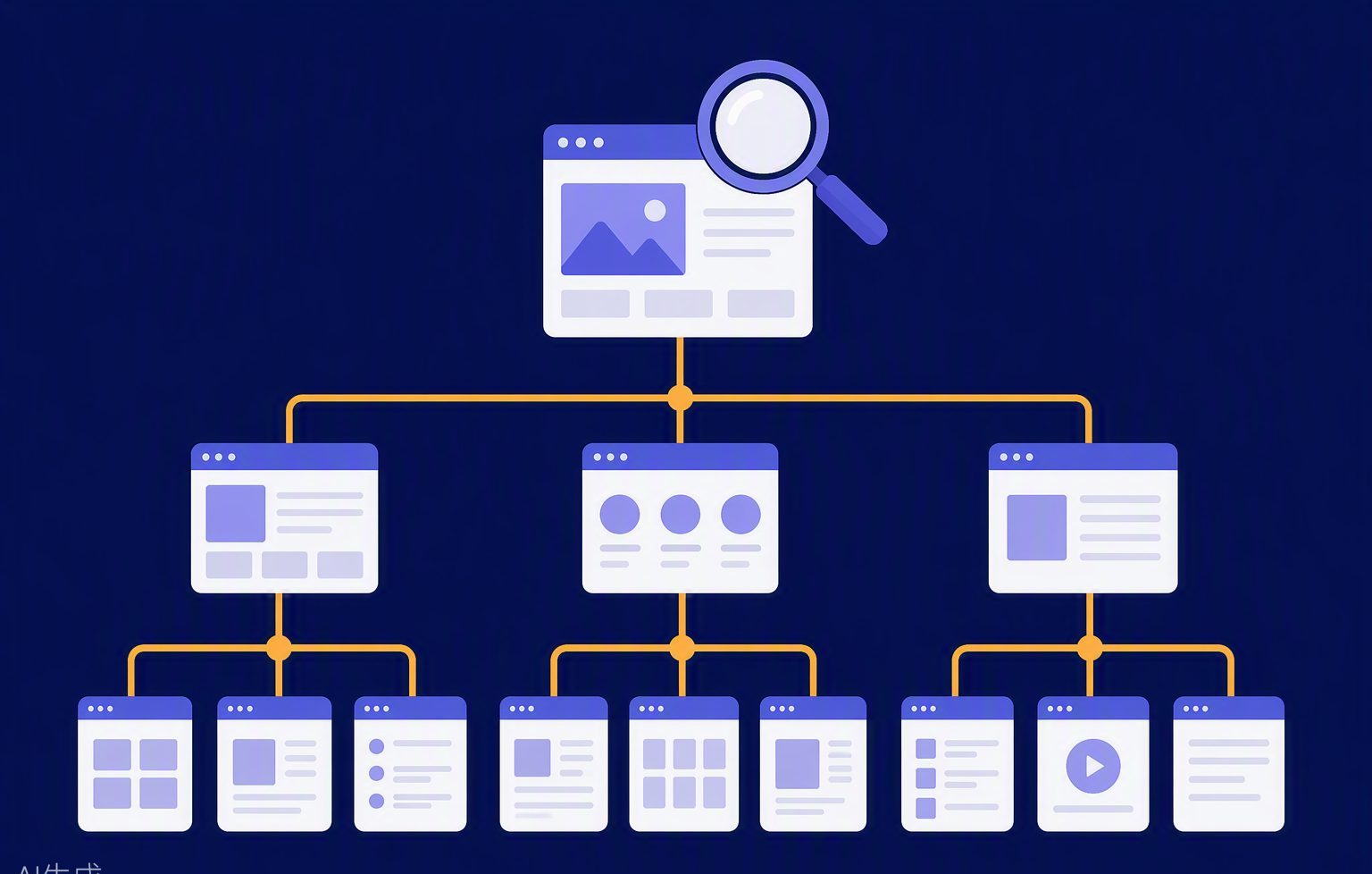
Website structure for SEO gets abstract very quickly. For a business that sells a few services, it should stay concrete. You are deciding which URLs exist, what each one is about, and how a customer moves from a general visit to a specific enquiry. Get that map right and the writing has somewhere to live. Get it wrong and every new page fights the homepage.
This is the model we use when a firm has between two and eight offers, one main area, and no need for a catalogue of hundreds of products. If that is you, you do not need a complicated information architecture. You need a small set of pages with obvious jobs. A broader introduction sits in how to structure a website for SEO. Here the focus is the service business.
The homepage is the front door, not the whole shop
The homepage should say who you are, where you work, and which services exist. It should link to each service by its real name. It can show a short proof point, such as years trading or a genuine review, and a clear way to call or write. It should not be the only page that mentions each service in a single scrolling list with no URLs of their own.
When the homepage tries to rank for every service at once, two things happen. Customers skim and miss the detail. Google has one URL to show for many different searches, so the more specific searches often go to a competitor who gave that job its own page.
One URL for each service you want found
Give each core service a page. The URL can be as plain as /boiler-repair or /seo-friendly-website-design. The page explains that service only: what it is, who it is for, the area, how to start, and what to expect. Link to contact. Link to one or two answers people need before they commit, if those answers exist.
If two services are always sold together and nobody searches for them separately, one page is enough. If people search for them with different words and different intent, split them. Structure is a response to demand, not a rule that every noun becomes a URL.
About, contact, and the pages that support trust
An about page is for the person who wants to know a human or a named team is behind the offer. Say where you are based, how the work is done, and how to reach you. A contact page repeats the phone number as a tappable link, the form, and the address if customers visit or you want the local listing to match.
Prices belong on a page when they are real and current. If prices vary, say what changes the price instead of hiding the subject. Coverage belongs in the service pages or in one clear “areas” explanation if you genuinely work across several towns. Do not create a near-copy page per town unless the service, the proof and the details are actually different.
Where guides fit
A blog is optional. Use it when a question comes up often enough to deserve a full answer: how long a job takes, what an SEO friendly website includes, how internal links should work. Each guide should sit next to a service, with a link up to that service and a link from that service back down. Guides that never connect to an offer are a diary. Guides that only exist to repeat the service page are duplication.
Keep the URLs predictable. /blog/website-structure-for-seo is easier to understand than /post?id=184. Grouping is nice, but on a small site a flat blog folder is enough. The structure Google needs is the links between the guide and the service, which you can plan using an internal linking strategy.
What to draw before anyone designs a template
Sketch boxes: Home at the top, services in a row, contact to the side, a few guides under the services they support. Draw arrows for the links that must exist. If a box has no arrow in or out, it is either a mistake or a page you do not need. This sketch is the website structure. The menu, the breadcrumbs and the in-text links should all agree with it.
When the sketch is stable, design the template around those page types: a service layout, a guide layout, a contact layout. A single fancy homepage template with nowhere for the other pages to live is how small sites become one long scroll with weak SEO.
Changing the structure later
You can add a service page when a new offer is ready. Give it a place in the menu, a link from the homepage, and a link from any guide that mentions it. If you remove a page, redirect the old URL to the closest useful page so old links and old rankings are not dumped on an error.
If you want that sketch turned into a site, the service pages and site structure are part of the build. Send the list of services you want people to find. That list is the structure.